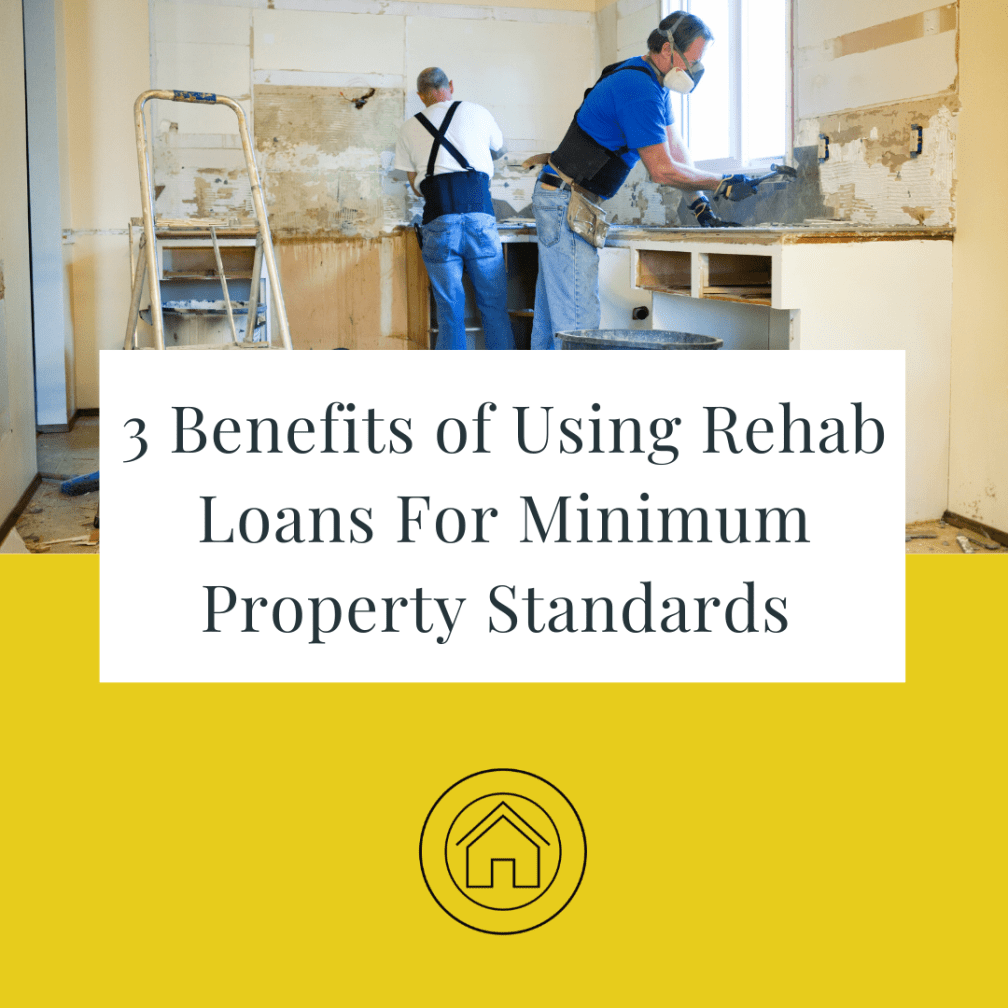
Rehab Loans for Minimum Property Standards: Why It’s a Smart Investment

When purchasing a home, meeting minimum property standards isn’t just a requirement—it’s an essential step toward protecting your investment. For many prospective homeowners or investors, using a rehabilitation loan to bring the property up to the basic standard is a cost-effective and smart strategy. Here’s why focusing on minimum property standards with a rehab loan can be a game-changer.

1. What Are Minimum Property Standards?

Minimum property standards are basic requirements that a property must meet to be considered safe, functional, and habitable. These standards vary by lending institutions but typically include structural integrity, safety features, plumbing, and electrical systems. Lenders, like FHA and VA, mandate that homes meet these standards before they’ll approve a loan, ensuring that the home is safe and suitable for its intended use.

2. How Rehab Loans Help Meet These Standards

Rehabilitation loans, such as FHA’s 203(k) or Fannie Mae’s HomeStyle loan, allow borrowers to finance repairs and upgrades into their mortgage. Rather than taking out separate loans or dipping into personal savings, borrowers can address necessary updates as part of their home financing package. This makes meeting minimum property standards achievable and accessible, even on a tight budget.

3. The Benefits of Using Rehab Loans for Minimum Standards

  • Cost Efficiency: By focusing only on repairs that meet minimum requirements, homeowners avoid the expense of full-scale renovations. This approach allows for affordable entry into a property with the assurance that it meets baseline livability and safety requirements.
  • Increased Home Value: Completing essential repairs can boost a home’s market value. Even basic updates improve the property’s condition, potentially increasing its resale value over time.
  • Future Investment Opportunities: Meeting minimum standards is a stepping stone. Once you’re settled, you can make additional improvements gradually, enhancing your home’s value and livability as your budget allows.

4. Choosing the Right Rehab Loan

Each rehab loan option has unique terms, so it’s essential to select the one that best aligns with your goals. An FHA 203(k) is ideal for first-time buyers or properties that require smaller-scale repairs, while the HomeStyle loan allows for a broader range of improvements.

Using a rehab loan to meet minimum property standards is a strategic move that enables you to own a home that’s both safe and structurally sound. This foundational investment opens the door to future possibilities, letting you transform the space into your dream home over time, while giving you a safe and solid place to start.

I talk more about this topic on my latest video on my YouTube channel. Watch it here!

hud 203k consultant, fha 203k loan

HUD 203K Consultant Role Explained: Working with Borrowers, Lenders, & Contractors

A HUD 203K Consultant plays a vital role in the FHA 203(k) rehabilitation loan process, especially before the loan closes. Their involvement ensures the project is feasible, meets FHA standards, and that both the borrower and lender have a clear understanding of the scope and costs. Here’s an overview of their pre-closing responsibilities:

1. Initial Property Assessment (Feasibility Study)

  • Feasibility Study: The consultant performs a detailed inspection of the property to assess its condition and determine the scope of necessary repairs and improvements. This ensures the property qualifies for the 203(k) loan.

  • Repair Recommendations: They identify which repairs are mandatory (to bring the home up to FHA standards) and which are elective, based on the borrower’s goals.

2. Cost Estimate Preparation

  • Work Write-Up: The consultant creates a detailed work write-up outlining the specific repairs and renovations needed. This includes labor, material costs, and a timeline for completion.

  • Cost Estimates: They prepare an itemized list of all project costs, ensuring that the repairs are feasible within the borrower’s budget and the loan limits.

3. Creating the Scope of Work (Work Write Up)

  • The consultant works with the borrower to develop a clear and detailed scope of work, which contractors will use to prepare bids. This helps prevent future disputes between the borrower and contractor over what work was agreed upon.

4. Contractor Bids and Selection

  • The consultant helps the borrower review contractor bids to ensure they align with the scope of work and cost estimates.

  • They may assist in ensuring that the selected contractor meets FHA guidelines and has the qualifications to complete the project.

5. Submitting Documents to the Lender

  • The consultant prepares the necessary documentation, including the scope of work and cost estimates, which the lender uses to approve the loan amount.

  • The consultant ensures that all FHA-required repairs and improvements are accounted for in the loan documents.

6. Ensuring Compliance with FHA Standards

  • The consultant ensures that the proposed renovations meet HUD and FHA standards. This includes both safety and structural requirements, as well as energy efficiency and livability standards.

7. Reviewing the Draw Schedule

  • The consultant establishes a draw schedule, outlining how and when the contractor will be paid as the work progresses. This schedule is critical for both the borrower and lender to ensure timely and proper payments.

8. Consultation with the Borrower

  • They serve as a liaison between the borrower, lender, and contractor to clarify expectations, answer questions, and make sure the borrower fully understands the renovation process before closing.

By facilitating clear communication and documentation, the 203(k) consultant ensures the borrower, lender, and contractor are on the same page, reducing the likelihood of future disputes.

WATCH me explain how I work with Loan Borrowers, Lenders, and Contractors in this 3-minute video!